Thursday, October 7, 2010

Chilli! As in "by the time I'm finished cooking, it'll be chilli!


Vegetarian Chili

(Serves 6)


Ingrediants:

-10 medium sized fresh tomatos (or canned equivalent)

-1 medium sized onion

-2 garlic cloves

-1 cup of celery-1 cup of corn

-1/4 cup of olive oil

-1 tablespoon of basil

-1/2 cup of green pepper

-1/2 cup of red pepper

-1 can of red beans

-1 box of whole grain pasta

-salt (optional)

-pepper (optional

-1/2 teaspoon of hot pepper (optional)

-1 can of tomato paste (optional)
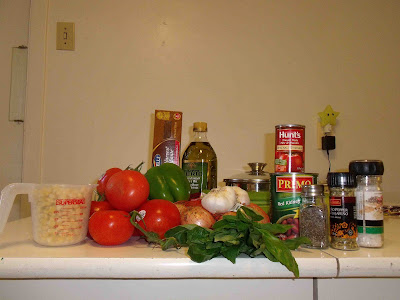
  1. Peel, divide and liquify fresh tomatos. To do this, simply bring a pot of water to a boil, and submerge tomatoes until skin becomes wrinkly and begins to detach. Remove tomatoes from water and then remove the skin. Then, divide each tomato into several smaller parts, so as to be more manageable when liquifying and to remove any tough parts. Then, using a handheld blender, blend the tomatos together until they become a homogenous solution. Add the result into a large pot.


  2. Dice all of the fresh vegetables, excluding corn, and add to the pot along with the basil, the spices, and the oil. Add more or less hot pepper depending on preference, then put the pot on the stove, cover it, bring it to a boil and allow it to cook for some time. Maintain boil on low heat.

  3. Open can of beans and drain any water, then add the beans and corn to the pot, and allow chili to cook until ingredients are of desired tenderness. For a chunkier chili, reduce cook time, or increase it for the opposite effect. If chili is too thin, tomato paste may be added. It is difficult to estimate the exact times it will take to cook chili, as much of it relies o

    n the individuals taste, therefore it is recommended to try small samples every so often, and to change cooking tactics accordingly.

  4. When chili is done, let sit for approximately 30 minutes to enhance flavouring. Durring this time, prepare pasta to be served with dish, by following the instructions on the box.

  5. Serve and enjoy!

My landlady is Chilean, and while Chile ha nothing to do with chili, it was an interesting parallel nonetheless. I told her about this project, and how I needed a recipe that had some sort of vegetarian protein source, all while having grains in the dish, and this was

her recipe. I'm a very slow cook, and it took me the whole of five hours counting preparation and clean up to make it, however, it was definitely worth it! It's a fairly simple recipe, and practically impossible to burn too, it's just time consuming if you aren't used to preparing a lot of vegetables quickly. However, It's important to note that many shortcuts can be taken, such as using canned beans and tomatoes, and powdered forms of garlic, onion, and hot peppers if time is an issue. For a skilled cook, or simply after repeating the recipe several times, it might take between an hour and an hour and a half to prepare it.

Aside from preparing comes eating, and though late, it was delicious! It could have used a tad less onion, as that's a taste I'm picky about in excess, but other

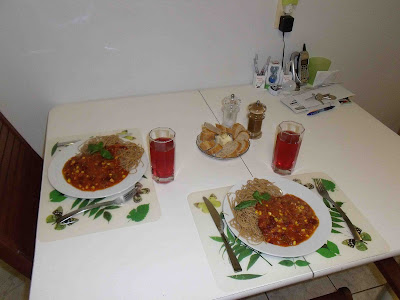
than that it was perfect. Because I work in a cafe, I'm used to making food look good. Presentation is everything, it's our first impression, so I didn't spare any bells and whistles when making this meal. As a result, my landlady loved it, and although she was apprehensive at first by the sheer size of the portions, she finished it all and long before me! I felt kind of bad about constantly asking her how to make it (when you spend more than an hour in the kitchen on one dish, you really don't want to make mistakes), so it was nice to be able to return the favor. The next day I also brought two portions to school, to share with my friend Samar as I'd originally invited her over for supper, but she couldn't make it that weekend. Once again, it was a hit and she finished before I did, saying that it tastes like her mother's chili. I really enjoyed preparing a whole meal, and it really taught me to appreciate the work that goes into i

t. When you cook for yourself it's much easier, and you rarely bother with large recipes, but as you cook for more people, you're forced to elaborate a bit more. Thus, there is more variety at my home in The Eastern Townships than here in Montreal.


Eating a vegetarian meal is not something I do all the time. My lunches and breakfasts are almost always vegetarian, however most of my suppers contain meat. If not, they only consist of pasta, and are always lacking a protein source. With the vegetarian chili, there is plenty of protein in the beans, and it's a cinch to cook up some pasta or cut up some bread. What's more, with the large variety of vegetables in the mix, there's a myriad of vitam

ins present, all in a low fat, healthy calorie meal. What's more, the oil in it could probably be reduced. Eating a vegetarian meal is much greener in every sense of the word, as meat often comes from unsustainable sources. The livestock raised are pumped with hormones and antibiotics, not to mention are succumbed to horrible living conditions and fed a corn based diet. Meat has a heavy carbon footprint compared to vegetables. While some of them are probably shipped from very far away, the onions and garlic in my recipe were from Quebec, and the celery was organic. If I was back in The Townships and had access to my vegetable garden, the bulk of it would be organic.

MY DELICIOUS RECIPE!!!!! :D


  • Rice and Beans!

    My recipe : COUSCOUS AND VEGETABLES

    Ingredients:

    -1 cup of fine couscous (steamed) –can be replaced with quinoa or whole wheat couscous. - 1 whole butternut squash cut in big chunks
    - 3 carrots, chopped
    - Zucchini, cut in cubes
    - 1 onion cut in slices
    - ½ cup chickpeas
    - Chicken broth (enough to cover all the vegetables in the pot)
    - 1 teaspoon turmeric
    - Pinch of salt
    - Pinch of pepper
    -1 bunch of coriander, chopped finely

    Preparation:

    This dish is quite easy to prepare. Couscous can easily be found in any super market such as Adonis or Maxi. My mother first cooks the couscous using a steamer. Then, the process is repeated once or even twice. My mother sometimes uses whole wheat couscous which is a healthier option. On the side, all kinds of vegetables are boiled together in a pot with chicken broth. We can use: zucchini, squash, onion, chickpeas, and carrot. Spices such as turmeric, coriander, salt, and black pepper are usually added to the vegetables. My mother then places the couscous on a serving plate and pours the vegetables on top and voila!

    In Middle Eastern culture, couscous is a very popular dish. My Moroccan family loves a good couscous with vegetables. This dish means a lot to me because it comes from my cultural background. My aunts, grandmothers and great grandmothers all prepared this dish for holidays. I will definitely continue this tradition because this is not only a delicious dish but also because it’s healthy. We sometimes change the couscous with a grain called quinoa because my sister is intolerant to gluten. Quinoa is a very healthy grain. It is gluten-free, high in fiber, and a complete protein. Since the quinoa is a complete protein, it is an excellent food choice for people who don’t eat gluten. The quinoa usually takes 10-15 minutes to cook. The vegetables that we mix with the couscous or quinoa are also very healthy, low in fat, full of fiber and nutritious ingredients.

Yellow Moong and Orange Lentil Rice

Group Activity: Rice and Beans!


Habib Ur Rehman

Overall (Recommended) Recipe (Serving Portion: 10):

Overall Time : 45 min


• Basmati Rice: 2 cup
• Salt: 1 tablespoon
• Water : Around 4 to 5 cups
• Onion: 1 medium size
• Garlic: 1
• Ginger: 2 teaspoon
• Coriander: Half a cup
• Red chili: 1 teaspoon
• Turmeric: 1 teaspoon
• Hot green peppers: 4
• Oil: 50 ml
• Tomato: 1 medium size
• Orange lentils dal: half a cup
• Yellow moong dal: half a cup


Step 1: Boiling Rice


Ingredients:

1. 2 cup of Basmati rice
2. 1 teaspoon of salt
3. 2 cups of water

First: Wash the rice in hot water
Second: Put 2 cups of water in a pot (on a stove)
Third: Add 1 tablespoon of salt in the water
Fourth: When the water is boiling, add the rice in the pot of water
Fifth: Leave them aside after cooked for later.

Step 2: Cooking


Ingredients:

1. Water : 3 3/4
2. Onion: 1 medium size
3. Garlic: 1
4. Ginger: 2 teaspoon
5. Coriander: Half a cup
6. Red chili: 1 teaspoon
7. Turmeric: 1 teaspoon
8. Hot green peppers: 4
9. Oil: 50 ml
10. Tomato: 1 medium size
11. Orange lentils dal: half a cup
12. Yellow moong dal: half a cup


First: Turn on the stove, in a pot pour 3 ¾ cups of water
Second: Put all the other ingredients in the pot.
Third: Wait until it cooks

Step 3: Cooking onions


Ingredients:

1. Onion: half
2. Oil: 20ml

First: Turn on the stove, in a pan add oil and onion.
Second: When the onions get orange, and mix them with what was cooked in the second step

Final Step: Mixing


Ingredients:


1. Boiled rice
2. Cooked lentils and yellow moong dal.
First: Mix the above mentioned things.

[Final picture not available for now]


In fact, this recipe comes from the area where my parents come from in Pakistan. Usually, in poorer families or where meat is not always available or affordable, this form of food is consumed by the people. Actually, there is a saying in this culture that goes as following: “Beans are for the poor; Chicken [(i.e. meat)] is for the rich.” Through this quote, in its attempted translation, that it could be understood that the same benefits (i.e. we would understand it as protein) can be attained when beans or anything of that nature I being substituted for meat (i.e. in this case, the poor have no choice). Nevertheless, this does not mean a rich person cannot have this meal. However, it would be much better if one were to decrease its intake of meat on regular basis; thus, eliminating certain health problems.


Further, the preparation of this meal, overall, was not that difficult excluding the peeling of onions! This food was shared with my family, who also in fact enjoyed it. I felt really amazed that in my first attempt to cook this meal, I was able to do it with a little help from my mother! In terms of health and environmental benefits, it is a meal with not only low-fat but also normal in calories; also, it does not involve any pollution since it was not shipped or packaged like the conventional food products found at the supermarkets, therefore, it was a homemade meal! If one is unable to find these ingredients for whatever reason, a local Indian store (or of that nature) can surely help you find them.


To conclude, this is a simple and healthy meal which can be prepared by any eager individual; and it is surely also delicious!

Meat And The World

This is the most interesting article that we read upon. We picked this up off our classmate : Roy Reyes de Leon.

http://www.greenmuze.com/climate/meat/334-meat-a-heat-.html

This is such an important article to us since it really highlights the true consequences of the meat we eat. We are more and more dependent on meats, and its affect on the enviorment is getting worse.
We learn that:
- A kilogram of beef results in as much warming potential as 36.4 kilograms of carbon dioxide.
- We need 2,500 gallons of water to produce one pound of meat.
- Grazing occupies 26% of the Earth's surface. ( terrestrial )
- Dead pigs, horses and poultry are fed to commercially grown cattle.
- They are also fed sawdust and news paper...
On top of it all, we learn that commercial meats are cheap sources of protein due to their diet. This article is brilliant in revealing key points about the North American meat diet.


The most disturbing article we came across is concerning the polution of the environment.

http://ymiblogging.org/2010/07/odb-garbage-island/

‘The Great Pacific Garbage Patch.’ features three million tons of plastic debris floating in an area larger than Texas. This is a Horrifying fact to all. We are destroying the earth, and its becoming worse and worse.
-Jordan Harroch, Michael Riva, Melissa Buono

Pasta Fagoli


Beans:

1 lb. White dried beans

3-4 tbsp. Olive oil

2-3 cloves of minced garlic

1 small onion chopped

1 tomato peeled and chopped

½ cup of chopped celery

Salt and pepper to taste


Pasta:

Pasta
Water

Salt


Preparation:

Soak beans for 12 hours in water. Drain and simmer with water (just enough to cover the beans) and other ingredients until beans are soft. There will be a thin layer on top. Remove layer. Serve on pasta.

This recipe has been past down from generation to generation in my family. It was originated in Italy where most towns make some type of variation of it because it is cheap and filling. This recipe is an extremely easy dish to prepare because all that is needed is to get the ingredients and through them in a pot, mix with pasta and serve. This recipe is both good for the environment and for health because of the simplicity of the ingredients. This is to say that all of the ingredients can be grown in one’s backyard or be made with little carbon emissions. All the ingredients are natural and easy to find. This is also good for the environment because it has been proven that it takes the same amount of fossil fuels to grow one kilo of beef as it does to drive your car around for three hours; and thus since this recipe does not have any meat, it helps reduce your carbon footprint. This dish is filled with lots of vitamins and proteins allowing one’s body to be healthy.

I shared this dish with my beloved sister who helped me prepare it. I felt quite proud of myself for preparing and serving this dish because it firstly filled my stomach, which makes me happy, and secondly made me feel extremely accomplished because I have never cooked a meal (other than toast and peanut butter) in my life.


Most Interesting Post

Dead Zones: How Agricultural Fertilizers are Killing our Rivers, Lakes and Oceans From Greenpeace Canada

We found this the most interesting article because you never think of fertilizers affecting something as enormous as the ocean. It's crazy how from trying to grow crops, the farmers are also growing a different type of organism: blue-green algae. Because algae has plant-like tendencies, it's obviously able to get nutrients from these fertilizers and are able to grow at alarming rates. The algae also photosynthesises and gets energy from the sun, and released CO2, which would normally be a good thing, if algae didn't die so easily. Because the algae doesn't live for long, there is a lot of dead material in the water, resulting in an Oxygen loss in the water. This is very interesting because it shows how one thing that a human does (too much fertilizer), can cause a chain reaction and is in the end, very devastating.

Food Fight Quebec

I think this link is the most horrifying, http://http//beyondfactoryfarming.org/get-informed/locations/quebec/hogs. It basically informs us about how the excess manure left from hogs are going into ground water and into our surface water. The government released a report to change this. http://http//www.beyondfactoryfarming.org/documents/conclusion_v_ang.pdf
One of the plants in Quebec was shut down and moved to Alberta.
(http://http//www.cma.ca/index.php/ci_id/19816/la_id/1.htm),
resolution 02-69
That CMA expresses its concern with regard to the risk to public health in rural areas that is presented by the developement of industrial hog farms.

Also, it talks about how much fossil fuels are being wasted to transport the farm animals, pork, poultry, beef. it releases carbone dioxide, sulfur dioxide which also contributes to global climate change.

How can we avoid this? We have to buy local meats, poultry, dairy. theres less travelling, therefore less pollution contaminating our air.

http://http//beyondfactoryfarming.org/get-involved/food-choices-have-climate-consequences
This site shows two ways of finding local food closest to you. Or you can become a proud supporter to Beyond Factory Farming.

Alexandra D'Amore
Nick MacIsaac

Water bottles vs Factory farms

The most shocking article was Clarence's "The story of bottled water" (http://www.storyofstuff.org/) link which described the many disadvantages of bottled water. The massive amount of waste that is produced by used water bottles is appalling, especially since we can get better quality water from our own tap. There is essentially no benefit to bottled water and it costs 1,900 times more and uses 2,000 more energy than tap water.


The most interesting article was Nick's post (http://beyondfactoryfarming.org/get-informed/locations/quebec/qu%C3%A9bec) regarding the decline of small farms in Quebec and how industrialized farming is taking over. The corporate concentration of agriculture in the province is such that 20 per cent of producers (with incomes greater than $250,000) generated 70 per cent of total agricultural revenue.

Neither of us usually buy water bottles but "The story of bottled water" has further discouraged us to do so in the future. Furthermore, we are now more compelled to convince others to avoid buying water bottles. In terms of discouraging factory farms, we think that supporting farmer's markets might be the best solution. Neither of us are aware of market locations but are willing to do some research.


By : Melanie Hansma and Qi Zhang

Wednesday, May 5, 2010

Earth Day

Earth day was extremely interesting. We met various amount of people who were in shock with the type of food people consume daily. I could honestly say that people have a hard time understanding that health is an important issue. That day was beautiful because in a way, the people that participated bonded with one another. It’s a plus, because we are trying to make a difference in our society with the way that we eat. The way animals are being treated in farms. The amount of people and children that are becoming obese is incredible. In a way, all these factors contribute to global warming. We want to make a change for our planet for the better. We want a healthier life style and we want to feel safe on our planet. We want to be healthy, we want to look good, we want to prevent our planet from becoming intoxicated and most importantly we want to live long.
Cheers to our planet!

Sunday, May 2, 2010

Earth Day

Earth Day was really interesting. I'm glad I was a part of this event and it was an experience I won't forget. My team; Nayiri, Sofia and I informed the students in Vanier College about the lack of clean water and food in underdeveloped countries. We explained how us Canadians are privileged to have clean water and can afford to have food. And we shouldn't be wasting any because countries like in India, many people are dying from water and food shortage. These problems and pictures we showed really shocked the students. I believe they learned something new and they should take this information in consideration. Other then informing the students, I was informed as well by participating by my curiosity what the other students had to enlighten me about.

Karine Philipossian